Hi all, new to drone flying but have a question.
As the max hight is 400 feet. If I am 600 feet up a hill or mountain and want to film the valley will the drone drop to 400 feet once I send it out of the lower ground, or is the hight set from the control unit.
Thanks
Reggie
I have asked this very question about flying from a cliff,I’ll try and find it
Thanks for that, but I see there is no answer. Will have to see if I can find it on the Web anywhere
The height is measured from take off point or controller so even if you are 600 ft up a mountain,your 400ft limit starts from there.The 400 ft maximum height is from the nearest point of the earth so lets say you are up your mountain,you can fly out over the valley but only to the point where the valley floor becomes the closest point of the earth and the drone will drop down to 400 ft.
As an example,say you are standing on a 500 ft cliff,your drone can effectively be 900ft above the valley floor (or sea) below the cliff.As long as you keep your drone within 400ft of the take off point,or closest point to the earth you will be fine so to my way of thinking,if you take your drone up 100 ft vertically,you can fly horizontally away from the cliff 300ft i.e 400ft from the closest point of the earth.Any further than that,the valley floor or sea then becomes the closest point and the drone will drop down to 400ft above that.
Does that make sense?
2 Likes
Hi, the purpose of being below 400ft (120m) is to keep separation from other powered aircraft. These have to fly at least 1,000ft above ground level. Unless landing or taking off. So the basic idea is to keep the minimum separation at 600ft.
So if you are standing on Mt Cheviot in Northumberland it is 2,674ft above sea level. Aircraft, such as light planes, have to fly no lower than 3,674ft asl and drones can fly at 3,074ft asl. The gradient of side of the mountain is about 14% which means that if you fly 305m from where the gradient starts the ground will be 400ft (120m) lower. It you maintain an altitude of 3,074ft you are now 800ft (240m) above the ground, at 355m you are 1,000ft above the ground which is where aircraft can legally fly. BTW, I have seen helicopters flying below 1,000ft over high ground when I have been flying so don’t assume everyone else follows the rules.
I was on the Malvern Hills recently where the gradient is more. As a rule of thumb all I do is remind myself to think about adjusting height when I get to 100m out then every other 50m if needed.
Enjoy flying…
2 Likes
A point not mentioned anywhere here that I can see is that you can fly higher than 120m above g.l. providing you remain closer than 50m to the side of a building or other structure and do not fly more than 15m above it. Obviously you would need to check that your maximium height setting will allow you to do this (and change if necessary). A drone will fly wherever you tell it to, legal or not.
1 Like
I’ve wondered about this myself when flying from higher locations…so in a nutshell…if I fly out past a certain distance and the ground level has steeply dropped off (for example), there’s a point where the drone will “check it’s height automatically and readjust” , thus making it correct itself and potentially drop to an unreacheable area?
Am I understanding this correctly? Thanks
1 Like
I’ve been thinking about this recently…today in particular, whilst walking along some coastal cliffs in East Yorkshire. I’ve googled and youtubed various questions and think my previous statement above is incorrect. I can’t find anything about the drone “recalibrating its height automatically” but I’ve seen quite a few mentions of the “drone sensor not being able to detect height”, and this is set at the controller end. More of a concern in these type of locations appears to be updrafts and intermittent increased swirling winds.
1 Like
That’s not true.
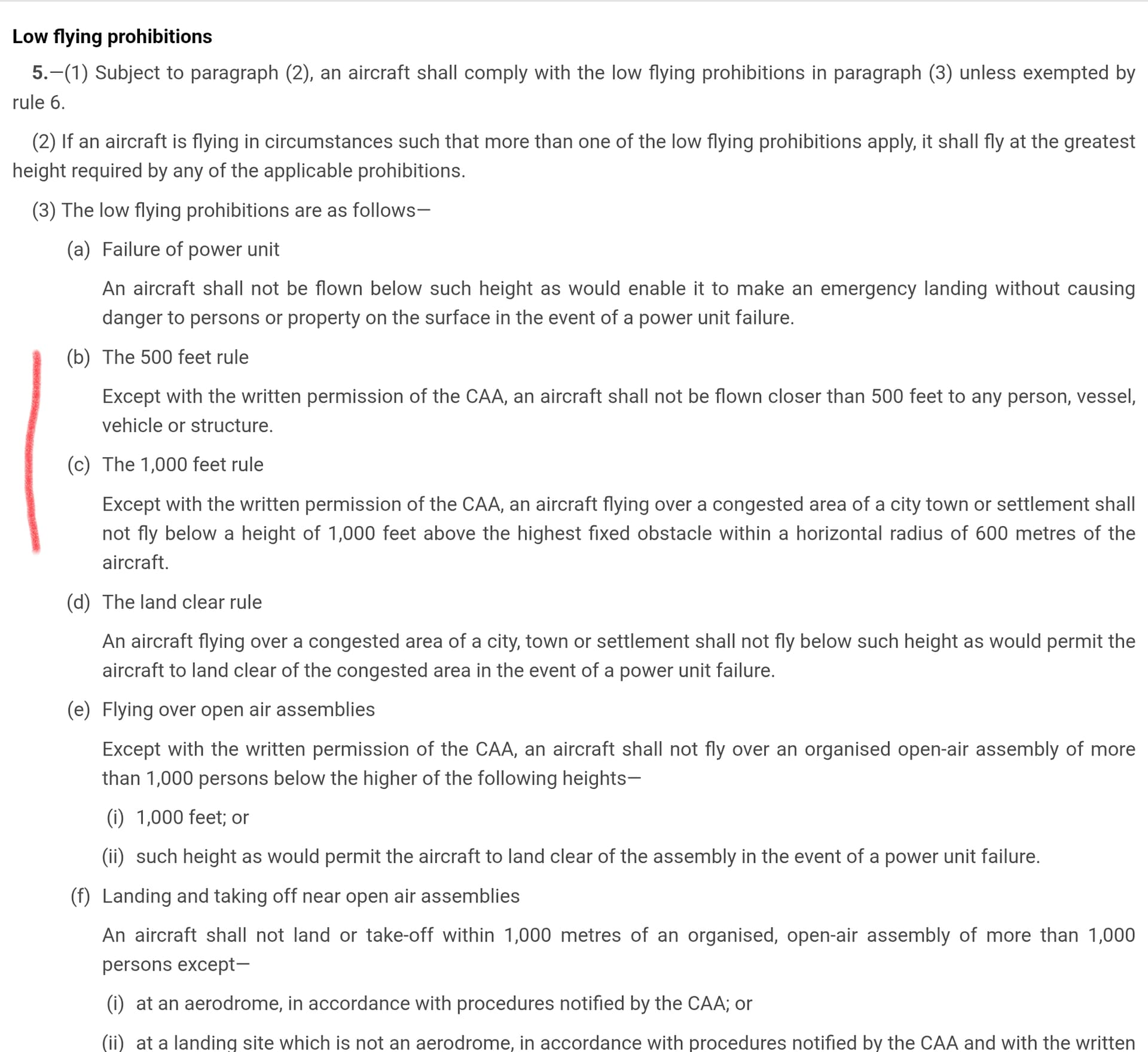
You’re thinking of “The 1,000ft rule”. That requires that you do not fly lower than 1,000ft of the tallest obstacle within 600m over a congested area of a city town or settlement.
The 500ft rule is more relevant. That says that an aircraft must not be flown within 500ft of any person, vessel, vehicle, or structure. That 500ft could be horizontal, or diaganol, it doesn’t necessarily need to be vertical. But, in the vast majority of cases, the 500ft rule, and the drone 400ft rule, means that there is at least 100ft separation between drones and GA.
1 Like
You are right Mt Cheviot only gets conjested by sheep. I had another example in mind and forgot to change to the relevant height for a remote location. The point is still separation.
2 Likes
The question is does the drone adjust its height to 400 feet automatically or does it not? We need a volunteer to find out. Any takers.
1 Like
After searching previously, I’m not aware of any drones automatically adjusting their height.
2 Likes